

Network Visibility Solutions for Hybrid Environments
A hybrid environment rarely fails all at once. What usually happens is more frustrating: a voice call breaks up for one office, a SaaS application slows down for remote staff, a branch firewall shows no clear issue, and the cloud team says their metrics look normal. At that point, network visibility solutions for hybrid environments stop being a nice-to-have and become the only practical way to see what is actually happening across the estate.
For IT teams supporting a mix of campus networks, branch locations, cloud workloads, VPN users, and wireless-first offices, the challenge is not a lack of data. It is fragmented data. Logs sit in one platform, packets in another, Wi-Fi performance in a separate tool, and infrastructure health somewhere else again. Without a clear view across these layers, mean time to resolution climbs, user confidence drops, and infrastructure decisions start relying on guesswork.
Why hybrid infrastructure changes the visibility problem
Traditional monitoring models were built for environments where most applications, users, and traffic paths stayed inside the corporate network. That assumption no longer holds. A user may connect over home Wi-Fi, authenticate through a cloud identity service, access a SaaS platform through the public internet, and rely on a branch SD-WAN path for another application minutes later.
That shift matters because visibility gaps now appear between domains rather than only within them. A network team may have strong switching and routing metrics but little packet-level insight into east-west traffic in a virtual environment. A cloud team may see workload health but not what happened on the access layer before the session reached the application. Wireless issues can also be misread as application issues when the real problem is poor RF design, interference, or roaming behaviour.
The result is familiar to most experienced teams: every domain looks healthy in isolation, but the user experience is still poor.
What effective network visibility solutions for hybrid environments should provide
The right approach is not simply to buy more dashboards. Effective network visibility solutions for hybrid environments need to connect telemetry from multiple layers so teams can move from symptoms to root cause quickly.
At a practical level, that means combining infrastructure monitoring with traffic analysis, packet inspection, and performance data from both wired and wireless networks. If a branch office reports slow access to a hosted application, the team should be able to test whether the issue is local congestion, DNS delay, WAN path degradation, poor Wi-Fi conditions, or an upstream application response problem.
This is where platform choice matters. Some organizations need broad infrastructure observability to monitor devices, interfaces, services, and dependencies across many sites. Others need deep packet visibility for security analysis, forensic investigation, or application troubleshooting. In most mature environments, both are needed, but not always in equal proportion.
Monitoring is not the same as visibility
This distinction is worth making because many teams already have monitoring in place and assume they have enough coverage. Monitoring tells you that something crossed a threshold. Visibility helps explain why.
If a switch uplink is saturated, monitoring will flag interface utilization. Visibility should tell you which applications, conversations, or misconfigurations caused the spike. If users complain about poor wireless performance, a monitoring alert might show AP load or channel use. Visibility should help determine whether the issue is RF overlap, client capability, retransmissions, or a backhaul bottleneck.
That difference becomes more important in hybrid environments because dependencies are less obvious. A single user complaint can involve the LAN, WLAN, WAN, DNS, internet edge, and cloud service all at once.
The core building blocks
Most organizations evaluating visibility strategy for hybrid operations will end up looking at four capability areas.
The first is infrastructure monitoring. This covers switches, routers, firewalls, servers, virtual machines, and services. It gives operations teams the health baseline they need and helps expose failures before users notice them.
The second is traffic and flow analysis. NetFlow, sFlow, IPFIX, and related telemetry provide a scalable way to understand who is talking to whom, over which paths, and in what volume. This is particularly useful when packet capture at scale is not realistic across every segment.
The third is packet-level analysis and forensics. When teams need to inspect transactions, validate performance issues, or investigate suspicious behaviour, packet data remains essential. It is more demanding from a storage and design standpoint, but there are cases where only packets provide the evidence required.
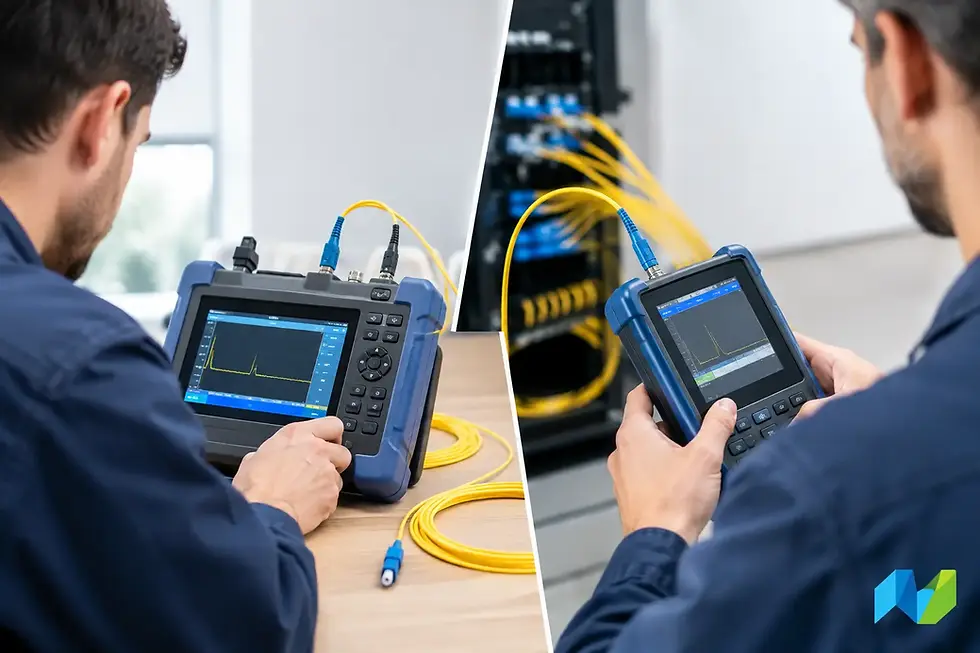
The fourth is wireless and physical-layer validation. In hybrid environments, user experience often begins with Wi-Fi and cabling quality. If the RF environment is poorly designed or the copper and fibre plant has faults, software-only monitoring will not tell the whole story.
Wired, wireless, and cloud must be treated as one service path
This is one of the most common operational mistakes. Teams divide ownership by technology domain, then troubleshoot by handoff. Wired checks the switch, wireless checks the AP, cloud checks the workload, and nobody sees the full path end to end.
A better model is to treat user experience as the unit of analysis. If a clinician in a hospital, a student on a campus, or a branch employee using VoIP experiences poor performance, the investigation should follow the service path across access, transport, application, and dependency layers. That requires tools that can correlate conditions rather than simply report them.
How to evaluate solutions without overbuying
Not every hybrid network needs the same architecture. A distributed enterprise with heavy SaaS use, branch routing complexity, and strict uptime requirements will need a broader visibility stack than a mid-sized organization with two sites and limited cloud dependency.
The key is to start with operational use cases. Are you trying to reduce troubleshooting time? Validate Wi-Fi performance before and after changes? Improve security investigations? Monitor infrastructure health across a growing multi-site footprint? Support compliance and evidence retention? Each answer points to a different mix of capabilities.
There are trade-offs. Deep packet capture offers excellent detail but adds design and retention considerations. Flow-based visibility scales well but may not answer every forensic question. Cloud-native monitoring can be strong within hosted platforms but weak when a problem begins on the branch LAN or over wireless. A single pane of glass is appealing, but if it flattens detail too aggressively, engineers may still need specialist tools to solve real incidents.
For many organizations, the best fit is a layered strategy: broad monitoring for estate-wide awareness, traffic intelligence for behaviour and dependency mapping, and targeted packet or wireless analysis where precision is required.
Where implementation often goes wrong
Visibility projects tend to fail for predictable reasons. One is poor data source planning. If taps, SPAN sessions, flow exports, wireless survey baselines, and cloud telemetry are not designed deliberately, teams end up with blind spots in the areas that matter most.
Another is assuming all sites deserve identical treatment. They do not. A data centre core, a branch office, and a warehouse with handheld devices have different risk profiles and different troubleshooting needs. Visibility design should reflect business criticality.
A third issue is treating the tool as the project. Tools matter, but operational workflow matters more. Alerts need ownership. Dashboards need to map to team responsibilities. Escalation paths need to be clear. Otherwise, visibility becomes a reporting exercise rather than an operational advantage.
The role of validation and support
This is where experienced guidance adds real value. It is one thing to deploy a platform. It is another to validate packet paths, optimize exports, tune thresholds, confirm wireless design assumptions, and make sure the resulting data supports the decisions your team actually needs to make.
In practice, organizations get better outcomes when visibility is tied to planning, implementation support, and ongoing technical guidance. That is especially true when infrastructure spans campus networks, branch sites, cloud services, and remote users. Advanced Network Devices Inc. works in that space because product selection alone is rarely enough. The design, fit, and support model matter just as much as the technology.
Network visibility solutions for hybrid environments as an operational discipline
The most effective teams no longer view visibility as a standalone toolset. They treat it as an operational discipline that supports performance, resilience, and accountability across the lifecycle of the network.
That includes pre-deployment validation, day-to-day monitoring, structured troubleshooting, capacity planning, and post-incident analysis. It also means accepting that visibility will evolve with the environment. As more applications move to SaaS, more users work remotely, and more organizations refresh wireless and edge infrastructure, the telemetry strategy needs to keep pace.
If you are assessing your current state, a good starting question is simple: when a user reports a service issue, can your team trace the problem across wired, wireless, WAN, internet, and cloud layers without switching between disconnected evidence sources? If the answer is no, the gap is not only technical. It is operational.
The organizations that handle hybrid complexity best are usually not the ones with the most tools. They are the ones with the clearest visibility model, matched to their infrastructure, their risk profile, and the way their teams actually work. That is where better decisions start.


Comments